
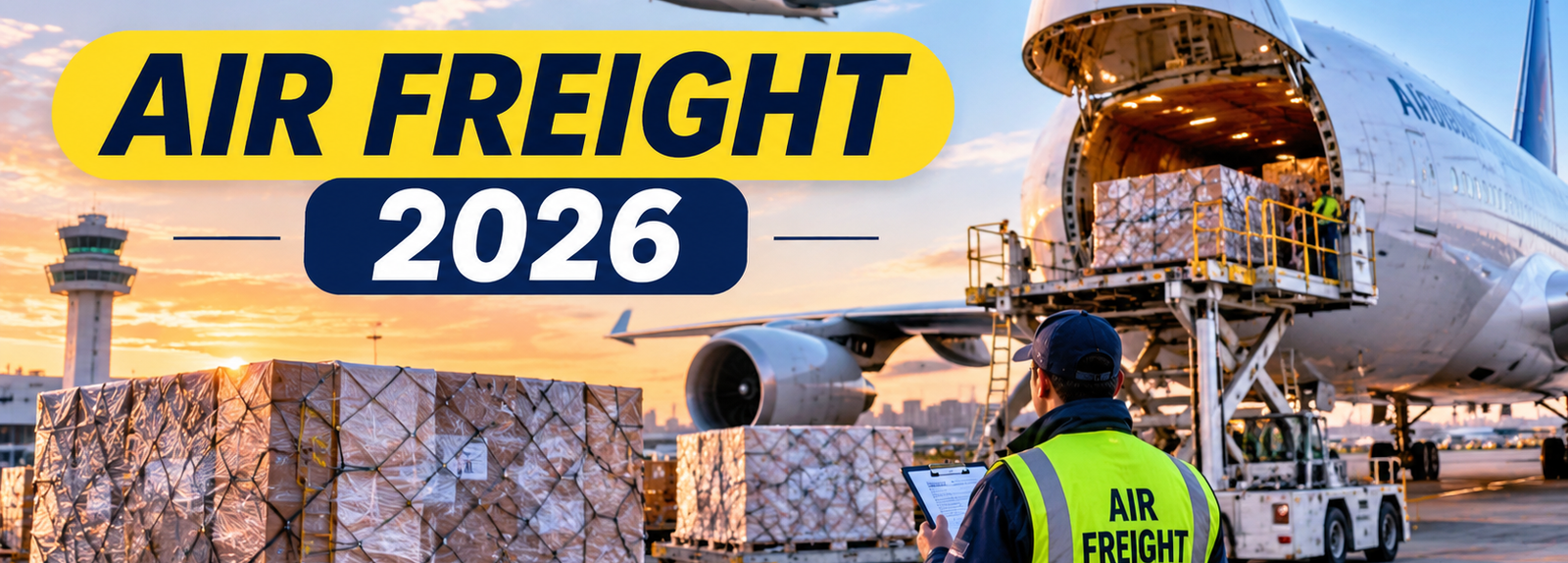

Air freight is the transportation of commercial goods by aircraft. For U.S. importers and exporters, it can shorten replenishment cycles, support urgent orders, and move high-value or time-sensitive products. The trade-off is that air cargo often costs more per kilogram than ocean freight, and the final price depends on dimensions, weight, route, security handling, customs processing, and delivery arrangements.
This 2026 guide explains how air freight works, how chargeable weight is calculated, what affects shipping costs, which documents are commonly needed for U.S. shipments, and how businesses can prevent avoidable delays.
What Is Air Freight?
Air freight is cargo transported on passenger aircraft or dedicated freighter aircraft. Airlines, freight forwarders, ground handlers, customs brokers, and delivery companies may each manage part of the shipment. Air freight is commonly used for electronics, samples, medical supplies, spare parts, fashion products, urgent inventory, and goods with a high value relative to their weight.
It is not automatically the best choice for every shipment. Heavy, bulky, low-value cargo may be more economical by ocean when the buyer has enough time. Compare the full landed cost and delivery deadline rather than speed alone.
How Does Air Freight Shipping Work?
- Request a quote: Provide origin and destination, cargo description, package count, dimensions, gross weight, ready date, and special handling needs.
- Confirm acceptance: The forwarder checks capacity, route, commodity restrictions, packaging, security status, and carrier requirements.
- Prepare cargo and documents: Pack, mark, and label the goods correctly. Prepare the commercial invoice, packing list, and any permits or dangerous-goods documents that apply.
- Export handling: The shipper or its agent completes applicable export formalities and security procedures in the country of origin.
- Flight and arrival: The cargo is processed at the origin airport, loaded, flown, and handled at the destination airport.
- U.S. customs processing: Required advance cargo data is transmitted to CBP by the responsible filer. The importer or broker arranges the customs entry and responds to any review or examination.
- Release and delivery: After customs release and settlement of applicable charges, cargo is collected or delivered to its final destination.
Air Freight Costs: What Is Included?
Air freight quotes may include different services. Ask the provider to itemize the air transportation rate, origin handling, export documentation, screening, fuel or other surcharges, destination terminal handling, customs brokerage, duties and taxes, storage, and final-mile delivery. Confirm whether the quote is airport-to-airport, door-to-airport, airport-to-door, or door-to-door.
A low headline rate may exclude important destination charges. Compare quotes on the same route, service level, cargo details, and delivery scope. Ask which charges are estimates and which are fixed, and how waiting time, storage, or customs examinations are billed.
Chargeable Weight: Actual vs. Volumetric Weight
Most general air cargo is rated using chargeable weight, usually the greater of actual gross weight and volumetric (dimensional) weight. A commonly used divisor is 6,000 cubic centimeters per kilogram, but the divisor and rounding rules can vary by carrier, route, service, and contract. Confirm the applicable method before booking.
Example: A carton measuring 60 × 50 × 40 cm has a volume of 120,000 cubic centimeters. Using a 6,000 divisor, its volumetric weight is 20 kg. If the actual gross weight is 14 kg, the shipment would generally be rated at 20 kg under that example’s rule. Measure every package accurately to avoid re-weighing charges. The TradeBridge CBM Calculator can help calculate cargo volume.
Common Air Freight Services
- Standard air freight: A balanced option when speed matters but the fastest service is unnecessary.
- Express air service: Time-definite transport, often with integrated pickup, customs support, and delivery.
- Consolidated air freight: Smaller shipments are grouped together. It can reduce cost, but consolidation schedules and handling can add time.
- Priority or direct service: Faster routing or preferred capacity, subject to availability and route schedules.
- Charter and specialized cargo: Used for urgent, oversized, unusual, or project shipments that do not fit standard services.
Documents Commonly Needed for U.S. Air Freight
- Air waybill (AWB): Identifies the shipment, shipper, consignee, routing, and handling details. It is not a negotiable document of title.
- Commercial invoice: Describes the goods, seller, buyer, value, currency, and sale details used for customs assessment.
- Packing list: Shows package count, contents, dimensions, and weights.
- Customs entry information: Supports classification, customs value, origin, and admissibility review.
- Permits or certificates: May be required for regulated food, medical, agricultural, chemical, animal, or other products.
- Dangerous-goods paperwork: Applies when the cargo is regulated as hazardous material for air transport.
Keep the cargo description, quantities, weights, values, and party details consistent across documents. Vague descriptions can lead to questions, holds, or enforcement action. Review CBP’s Basic Importing and Exporting guidance and confirm commodity-specific requirements before dispatch.
U.S. Air Cargo Security and Advance Data
Air cargo is subject to aviation security controls. Depending on the shipment and transportation arrangement, the shipper may need to work through an airline, freight forwarder, or regulated indirect air carrier and complete applicable screening or shipper-validation steps. Ask the provider about cargo security status, screening arrangements, acceptance cut-offs, and the information it needs before cargo is tendered.
For inbound commercial air cargo, CBP requires advance electronic cargo information under applicable air manifest rules. The filing party and deadline depend on the route and circumstances. CBP guidance states that data for certain nearby foreign areas is due no later than aircraft departure, while data for other foreign areas is generally due no later than four hours before arrival. Confirm who is responsible for filing and ensure master and house air waybill data is accurate. See the CBP Air Commerce Manifest Flyer and the TSA Cargo Screening Program.
Shipping Dangerous Goods by Air
Some everyday products may be regulated for air transport, including certain lithium batteries, aerosols, flammable liquids, and chemicals. Before offering such cargo, identify its correct classification and confirm packaging, marks, labels, documentation, training, and carrier acceptance requirements. Rules depend on the material and shipment configuration, and airlines may apply additional restrictions. Review the FAA guide to shipping dangerous goods and consult a qualified specialist. Never misdescribe regulated goods to avoid a restriction.
Air Freight vs. Ocean Freight
| Factor | Air freight | Ocean freight |
|---|---|---|
| Transit | Usually faster | Usually slower |
| Cost per kg | Usually higher | Often lower for large volumes |
| Best fit | Urgent, compact, higher-value goods | Large, heavy, less urgent shipments |
| Constraints | Aircraft size, weight, security, and acceptance limits | Container, vessel, and port constraints |
Choose based on total landed cost, inventory carrying cost, product value, stockout risk, and delivery deadline. Compare your estimate with the TradeBridge Shipping Cost Estimator.
How to Choose an Air Freight Forwarder
- Request a written, itemized quote with clear service scope.
- Check experience with your product category and origin-destination lane.
- Confirm routing, estimated transit time, cut-offs, and tracking milestones.
- Ask who files advance cargo data and who arranges customs entry.
- Verify dangerous-goods, temperature-control, or special-cargo capability when relevant.
- Understand cargo insurance options, liability limits, claims procedures, and exclusions.
- Get a named contact for customs questions, exceptions, and delivery coordination.
Common Air Freight Mistakes to Avoid
- Giving incorrect package dimensions or gross weights.
- Using vague cargo descriptions or inconsistent invoice details.
- Assuming the quote includes destination handling, brokerage, duties, taxes, and delivery.
- Missing airport cargo acceptance or document cut-offs.
- Failing to disclose batteries, liquids, chemicals, or other potentially regulated goods.
- Leaving classification, origin, and admissibility checks until after the cargo arrives.
- Not planning for storage, examination, or delivery delays.
Air Freight Booking Checklist for 2026
- Confirm origin, destination, delivery address, and required arrival date.
- Measure each package and record accurate gross weights.
- Provide a precise cargo description, value, and country of origin.
- Check product restrictions, permits, and dangerous-goods status.
- Prepare invoice, packing list, and air waybill data.
- Agree who handles security screening and advance cargo filings.
- Confirm importer details, tariff classification, broker, and entry arrangements.
- Review origin, freight, destination, duty, tax, and delivery charges.
- Keep tracking details and a contingency plan for exceptions.
Frequently Asked Questions About Air Freight
How long does air freight take?
Transit time depends on route, flight availability, service type, consolidation, customs processing, and final delivery. Ask for both airport-to-airport and door-to-door estimates.
Is air freight charged by actual or volumetric weight?
Most general cargo is rated using chargeable weight, usually the greater of actual gross weight and volumetric weight. Confirm the divisor and rounding method with the provider.
Does air freight include customs clearance?
Not always. Some door-to-door services include brokerage, while airport-to-airport quotes may exclude entry, duties, taxes, storage, and local delivery. Check the written quote.
Can batteries be shipped by air?
Some batteries can be shipped when they meet applicable classification, packaging, marking, labeling, documentation, and carrier requirements. Restrictions vary by battery type and shipment configuration.
Is air freight better than ocean freight for U.S. imports?
It can be better when speed, product value, or stock availability is critical. Ocean freight is often more economical for large or heavy shipments when the schedule allows more time.
Final Thoughts
Air freight gives U.S. businesses speed and supply-chain flexibility, but a successful shipment depends on more than booking an aircraft. Accurate measurements, complete documentation, cargo security, advance data, customs preparation, and a clear understanding of every charge help reduce avoidable delays and costs. Compare providers on the full service and landed cost—not just the headline rate—and confirm current requirements for your specific goods before shipping.
Disclaimer: This article is general educational information, not legal, customs, tax, or dangerous-goods advice. Rules and carrier procedures can change. Confirm current requirements with CBP, TSA, FAA, relevant partner government agencies, your carrier, and a qualified customs broker or freight professional.
