
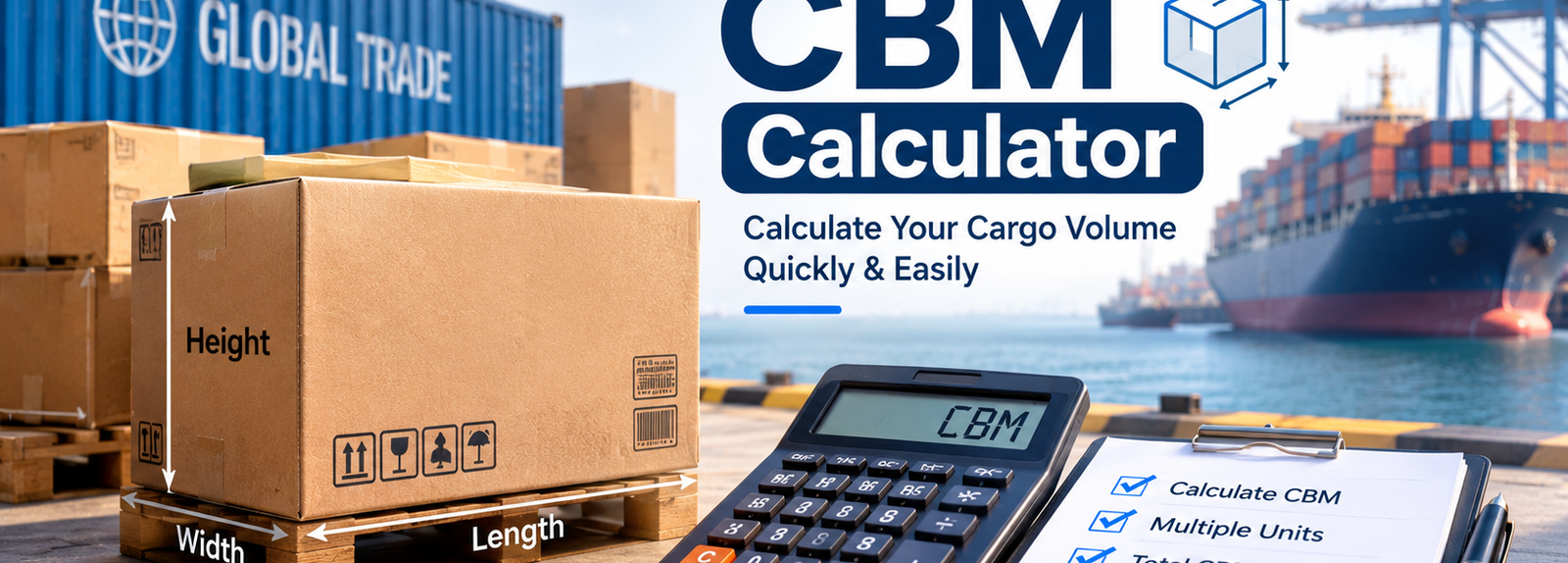

Use this free CBM calculator to calculate the volume of cartons, boxes or rectangular cargo for shipping. Enter the outside dimensions of each packed carton, choose a unit and add the number of identical cartons.
Calculate your shipment volume
All dimensions in a row use the selected unit. Add another row for cartons with different sizes.
Volume estimate only. This tool does not calculate freight prices, customs duties or carrier chargeable weight.
What is CBM?
CBM means cubic meter, a measure of volume. One cubic meter is the space occupied by a cube measuring one meter on each side. Freight quotes often use cargo volume alongside weight and service-specific rules.
CBM formula
CBM = length × width × height in meters × number of cartons.
For centimeters, divide each dimension by 100. For millimeters, divide by 1,000. For inches, multiply by 0.0254. For feet, multiply by 0.3048.
Worked example
A carton measuring 60 × 40 × 50 cm occupies 0.6 × 0.4 × 0.5 = 0.12 CBM. Ten identical cartons occupy 1.20 CBM. Always use the packed outer dimensions, including packaging.
How to use the CBM calculator
- Measure the length, width and height of the packed carton.
- Select centimeters, millimeters, meters, inches or feet.
- Enter the number of identical cartons.
- Add a separate row for every different carton size.
- Select Calculate CBM to see the total volume and carton count.
Frequently asked questions
Can I calculate different carton sizes together?
Yes. Add a row for each size. The calculator converts each row to meters and adds all carton volumes.
Is CBM the same as chargeable weight?
No. CBM measures volume. Carriers may compare actual and dimensional weight or apply volume-based minimum charges. Ask your carrier which pricing rules apply.
Does this calculate container capacity?
No. A shipment’s total CBM does not determine whether it will physically fit in a container. Packing layout, door dimensions, weight limits and stacking restrictions also matter.
Can I use this for pallets?
Yes, for rectangular packed pallets. Measure the full outside dimensions, including the pallet and any overhang, then enter the number of identical pallets.
Tips for accurate CBM measurements
Measure every carton after it has been packed, sealed and prepared for collection. Use the outermost length, width and height rather than the product dimensions inside the box. Include bulging packaging, corner protectors and any pallet overhang. Record all three measurements in the same unit before entering them, and check that the quantity matches the packing list. A small measurement error repeated across many cartons can noticeably change the shipment total.
For cartons that are not perfectly rectangular, ask your freight forwarder how it measures irregular cargo. Carriers may use the longest points or apply their own measurement and rounding rules. Keep photos and a measurement sheet for unusual packages so you can explain differences if the carrier re-measures the freight.
CBM versus volumetric weight
CBM is a volume measurement, not a weight. A carrier may convert dimensions into volumetric or dimensional weight using a divisor set by the transport mode and service. That divisor is not universal: air, express courier and ocean freight calculations can differ. For example, DHL explains its own dimensional-weight method and the comparison with actual weight in its chargeable weight guide. Always confirm the current divisor and billable-weight rules with the carrier quoting your shipment.
What your CBM result does not include
This calculator totals the cubic volume of the dimensions you enter. It does not confirm container fit, stacking strength, pallet layout, cargo weight limits, freight rates or customs charges. A freight forwarder may also consider container door openings, usable internal dimensions, weight distribution and whether cargo can be stacked safely. Use the total CBM as a planning figure, then request a written quote based on the final packing list and shipment details.
For more planning help, read our China to USA shipping cost guide and HTS code lookup guide.

4 COMMENTS
Comments are closed.