
How to import from China to USA involves more than choosing a supplier and paying for shipping. U.S. importers must confirm product eligibility, classify goods under the Harmonized Tariff Schedule (HTS), calculate landed costs, arrange transportation, and prepare customs entry documents. This step-by-step guide explains the process for first-time importers and small businesses.
Important: Tariffs, trade remedies, product restrictions, and customs requirements can change. Verify current requirements with U.S. Customs and Border Protection (CBP), the U.S. International Trade Commission (USITC), and relevant product regulators before placing an order.
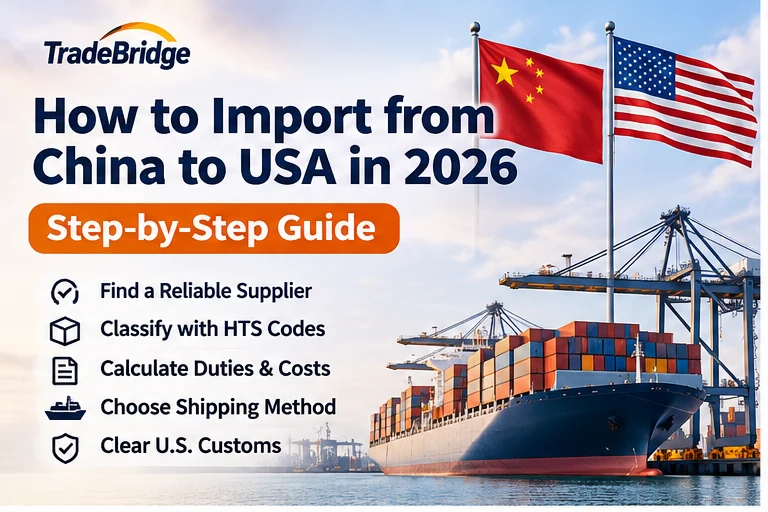
How to import from China to USA: quick checklist
- Choose a product and confirm that it can legally enter the U.S.
- Identify and vet potential suppliers.
- Request samples, specifications, and inspection arrangements.
- Determine the appropriate HTS classification and country of origin.
- Check applicable tariffs, trade remedies, and product-specific regulations.
- Estimate product, freight, duty, brokerage, and delivery costs.
- Agree on payment terms and an appropriate Incoterms rule.
- Arrange shipping, cargo insurance, and customs brokerage.
- Prepare entry documents and confirm filing obligations.
- Inspect delivery, reconcile costs, and retain records.
Step 1: Choose a Product and Check Import Restrictions
Start with a precise product description: materials, function, intended use, manufacturer, and labeling. Requirements differ for food, cosmetics, children’s products, electronics, medical devices, textiles, and other regulated goods. Depending on the product, agencies such as the FDA, CPSC, USDA, or FCC may have additional rules. Do not assume that a supplier’s statement of compliance is sufficient.
Step 2: Find and Verify a Chinese Supplier
Compare manufacturers and trading companies using business registration information, product capabilities, sample quality, lead times, quality-control processes, and documented export experience. Request written specifications and a sample before committing to a large order. Consider an independent pre-shipment inspection for higher-risk orders.
Supplier verification checklist
- Verify legal company name and operating address.
- Confirm whether the seller manufactures or resells the product.
- Request samples and written technical specifications.
- Document quality tolerances, packaging, and labeling.
- Agree on inspection, defect handling, and dispute procedures.
- Use traceable payments and retain invoices and correspondence.
Step 3: Determine the Correct HTS Code
U.S. import duties depend heavily on the product’s HTS classification, customs value, origin, and applicable measures. Search the official USITC Harmonized Tariff Schedule using the product’s characteristics. A supplier-provided HS code can be a starting point, but the U.S. importer is responsible for exercising reasonable care in classification and entry. Seek qualified customs advice or a CBP ruling when classification is uncertain.
Step 4: Check Import Duties, Tariffs, and Other Fees
Calculate the applicable base duty rate, then investigate additional duties or trade remedies that may apply to the product and origin. These can include Section 301 measures, antidumping or countervailing duties, and other current measures. Also account for customs brokerage, applicable processing fees, cargo insurance, and domestic delivery. Avoid relying on a single generic tariff percentage.
For background on tariff classifications and customs fees, read our USA Customs and Import Duties Guide.
Step 5: Calculate Total Landed Cost
When evaluating how to import from China to USA profitably, calculate costs at the final delivery address rather than comparing product prices alone. You can use the TradeBridge landed cost calculator to organize verified charges and the import duty estimator for a transparent estimate based on independently checked rates.
Illustrative landed cost = goods cost + origin charges + international freight + insurance + applicable duties and fees + customs/brokerage + destination delivery. Which charges are borne by the buyer depends on the contract and chosen Incoterms rule. Compare costs per unit at the final delivery point, not just the supplier’s quoted factory price.
Illustrative example (not a tariff quote)
| Cost component | Example amount |
|---|---|
| Goods (500 units) | $2,500 |
| Freight and insurance | $650 |
| Illustrative duties and entry fees | $400 |
| Brokerage and domestic delivery | $350 |
| Estimated landed cost | $3,900 ($7.80 per unit) |
The $400 amount is purely illustrative; actual duties and fees require product classification and current rules. Do not use this example to quote a customer or file customs paperwork.
Step 6: Choose Shipping Terms and Transport
For first-time importers, request written quotes from multiple freight providers using the same factory address, destination ZIP code, carton count, weights, dimensions, delivery deadline and agreed Incoterms. Confirm whether customs clearance, insurance, terminal handling and final delivery are included. A cheaper base freight quote may lead to higher overall landed costs.
Common options include express courier, standard air freight, less-than-container-load (LCL) ocean freight, and full-container-load (FCL) ocean freight. Compare total door-to-door cost, shipment size, handling, insurance, and delivery deadlines. Incoterms such as FOB, CIF, and DDP allocate certain obligations differently; confirm the named place and version in your contract.
For weight-based air and courier estimates, consult our China to USA Shipping Cost per KG Guide. Treat published freight ranges as benchmarks, not live quotes.
Step 7: Prepare Customs Entry Documents
Documents commonly include a commercial invoice, packing list, bill of lading or air waybill, and entry information required by CBP. Depending on the shipment, an importer identification number, customs bond, Importer Security Filing (ISF) for applicable ocean cargo, permits, or partner-government-agency data may also be required. Coordinate with a licensed customs broker when appropriate.
Step 8: Clear Customs and Receive Your Shipment
Check shipment milestones, respond promptly to broker or CBP requests, and verify quantities and condition on arrival. Reconcile actual landed costs against the estimate and document supplier performance for future orders. Maintain import records in accordance with applicable requirements.
Common Mistakes First-Time Importers Should Avoid
Learning how to import from China to USA also means building a repeatable compliance file. Keep your supplier agreement, invoices, product specifications, classification rationale, origin evidence, inspection documents, entry records and shipping confirmations organized. Check current government notices before each shipment: tariff treatment and product requirements can change after a guide is published.
- Ordering bulk inventory before testing samples.
- Using an unverified HS/HTS classification.
- Ignoring product safety, labeling, or agency requirements.
- Comparing supplier quotes without checking Incoterms and destination fees.
- Assuming duties are included in freight charges.
- Skipping inspection, insurance, or customs documentation.
- Relying on outdated tariff information.
Frequently Asked Questions about how to import from China to USA
Do I need an import license to import from China into the USA?
There is no universal import license for every product. Specific goods may require permits, registrations, approvals, or other agency requirements. Verify rules for your exact product.
How much does it cost to import from China to the USA?
Total cost varies by product, order size, freight mode, customs value, classification, origin, applicable duties, and destination. Calculate landed cost using shipment-specific figures.
Is DDP always the best shipping term?
No. DDP can simplify some buyer-facing arrangements but creates important responsibility and compliance questions. Verify who acts as importer of record, who makes customs declarations, and whether the seller can legally fulfill the obligations.
How can I check the current U.S. import tariff?
Start with the official HTS, then check applicable current trade measures and CBP guidance. For complex products, consult a licensed customs broker or customs attorney.
Official Resources
- U.S. Customs and Border Protection — Import/Export
- USITC — Harmonized Tariff Schedule
- International Trade Administration
- Consumer Product Safety Commission — Business Guidance
Editorial note: This draft is educational and does not constitute legal, customs, or tax advice. Verify tariff and compliance details immediately before publication and periodically thereafter.