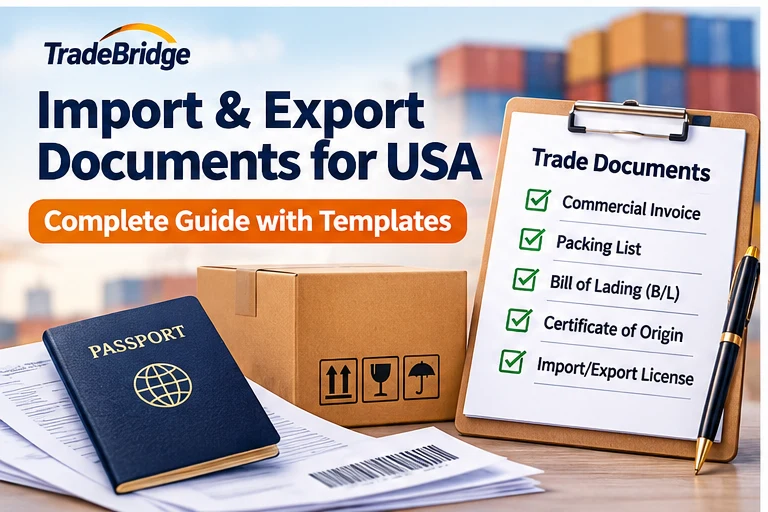

Import export documents are essential for businesses that buy and sell products across international borders. These records help importers and exporters identify goods, declare shipment values, verify the country of origin, complete customs procedures, and coordinate transportation. This 2026 guide explains the key import export documents that businesses working with the United States should understand before shipping.
Import-export documents help businesses identify products, declare shipment values, verify the origin of goods, complete customs procedures, and coordinate transportation between countries.
In this complete 2026 guide, you will learn about the most important import and export documents, their purposes, US customs requirements, and how to prepare paperwork correctly to avoid unnecessary shipping delays.
What Are Import-Export Documents?
Import-export documents are official business, shipping, financial, and regulatory records used when products move between countries.
These documents provide important information about a shipment, including:
- Product descriptions and quantities
- Buyer and seller information
- Shipment value and payment terms
- Country of origin
- Transportation details
- Customs declarations
- Product compliance information
Importers, exporters, customs brokers, freight forwarders, shipping companies, and government authorities may all use these records during an international transaction.
The exact documentation depends on the product, destination country, transportation method, and applicable trade regulations.
Why Are Import-Export Documents Important?
Proper documentation helps international businesses complete transactions more efficiently and reduce compliance risks.
Here are the main reasons businesses need accurate import-export paperwork.
1. Customs Clearance
Customs authorities use shipment information to assess duties, taxes, admissibility, and regulatory compliance. Missing or incorrect information can result in additional questions, inspections, or delays.
2. International Shipping
Shipping companies and freight forwarders use transportation documents to identify cargo, confirm shipping arrangements, and coordinate delivery.
3. Payment and Financial Records
Commercial invoices and other financial records help buyers, sellers, banks, and payment providers verify transaction details.
4. Legal and Regulatory Compliance
Certain products require permits, certificates, declarations, or approvals before they can enter or leave a country.
5. Better Business Organization
Maintaining complete records helps businesses track shipments, resolve disputes, prepare financial statements, and respond to customs inquiries.
15 Essential Import-Export Documents in 2026
Different international shipments require different paperwork. The following documents are among the most commonly used in international trade.
1. Commercial Invoice
A commercial invoice is one of the most important documents in international trade. It is prepared by the seller and provides transaction details for the buyer and customs authorities. It is a core part of the import export documents used to support customs valuation.
It generally includes:
- Exporter and importer details
- Invoice number and date
- Product descriptions
- Quantity and unit price
- Total transaction value
- Currency
- Country of origin, where required
- Applicable delivery and payment terms
US importers should ensure that invoice information accurately represents the transaction and supports the customs entry.
2. Packing List
A packing list explains how products are packed for transportation and is one of the standard import export documents checked by carriers and customs teams.
It typically contains:
- Number of packages
- Product descriptions
- Net weight and gross weight
- Package dimensions
- Marks and package numbers
- Packing details
A packing list helps customs officials, freight forwarders, and warehouse teams identify and handle cargo.
3. Bill of Lading
A bill of lading (B/L) is an important maritime transportation document issued by or on behalf of a carrier.
Depending on its type and terms, it can serve as a receipt for cargo, evidence of the contract of carriage, and a document of title.
It normally identifies the shipper, consignee, carrier, cargo, and shipment details.
4. Air Waybill
An air waybill (AWB) is used for air cargo shipments.
It provides transportation information and acts as a receipt for goods accepted by the airline or its agent. Unlike a traditional negotiable ocean bill of lading, an air waybill is generally not a document of title.
5. Certificate of Origin
A certificate of origin identifies the country where goods originate under the applicable origin rules. It can be an important part of import export documents when origin affects duties or trade preferences.
It may be required by the importing country, a buyer, or a preferential trade agreement.
Correct origin information can be important when determining eligibility for preferential tariff treatment.
6. Import License
Some products require an import license or authorization before entering a country.
Requirements depend on the product and the responsible government agency. Importers should confirm licensing requirements before placing an international order.
7. Export License
Certain products, technologies, and destinations may require export authorization under US export control laws.
US exporters should determine whether their products are controlled and whether a license or other authorization is required before shipment.
8. Pro Forma Invoice
A pro forma invoice is a preliminary document provided by the seller before a final commercial invoice.
It usually outlines estimated prices, quantities, products, and proposed transaction terms. Buyers may use it to review a purchase or arrange financing.
It is not normally a substitute for the final commercial invoice.
9. Customs Declaration
Customs declarations provide information about goods entering or leaving a country.
For US imports, import entry information is generally submitted electronically through the applicable CBP systems by the importer or its authorized representative.
Export shipments may require Electronic Export Information (EEI) filing through the Automated Export System (AES), depending on the shipment and applicable exemptions.
10. Insurance Certificate
An insurance certificate provides evidence of cargo insurance coverage.
It may include information about the insured party, shipment, coverage, and policy details. Businesses should review the actual policy terms rather than relying only on the certificate.
11. Inspection Certificate
An inspection certificate records the results of an inspection performed by an authorized or agreed inspection provider.
It may be requested for quality control, product specifications, quantity verification, or regulatory purposes.
12. Phytosanitary Certificate
A phytosanitary certificate is used for certain plants and plant products to demonstrate compliance with applicable plant health requirements.
In the United States, the USDA Animal and Plant Health Inspection Service (APHIS) is an important authority for plant health requirements.
13. Certificate of Analysis
A certificate of analysis (COA) provides test results showing whether a product meets specified quality or technical requirements.
It is commonly used for chemicals, food ingredients, pharmaceuticals, and other regulated or quality-sensitive products.
14. Letter of Credit
A letter of credit is a payment undertaking issued by a bank under specified conditions.
In international trade, it can help reduce payment risk when the seller presents documents that comply with the letter of credit’s terms.
15. Delivery Order
A delivery order is an instruction or authorization used in the cargo release and delivery process.
The exact process and issuing party depend on the carrier, port, freight arrangement, and destination.
Import-Export Documents Required in the USA
Businesses importing products into the United States must follow requirements administered by US Customs and Border Protection (CBP) and other relevant government agencies.
Common documentation and information may include:
- Commercial invoice
- Packing list
- Bill of lading or air waybill
- Importer identification information
- Customs entry documentation
- Country-of-origin information
- Product-specific permits or certificates, when applicable
- Additional information requested by CBP or another agency
The importer of record is responsible for using reasonable care to provide accurate entry information and ensuring that applicable import requirements are met.
US Import Documentation Requirements
US importers should pay particular attention to the following:
Customs Entry: Import entries are generally filed electronically through CBP’s systems, often with assistance from a licensed customs broker.
Tariff Classification: Products must be classified under the appropriate Harmonized Tariff Schedule of the United States (HTSUS) classification.
Customs Valuation: Importers must determine the proper customs value according to applicable US valuation rules.
Country of Origin: Origin must be accurately identified, including any applicable marking requirements.
Partner Government Agencies: Products regulated by agencies such as FDA, USDA, EPA, and other authorities may require additional declarations, permits, or approvals.
US Export Documentation Requirements
US exporters should also review documentation and reporting requirements before shipping goods internationally. Preparing the right import export documents before dispatch helps prevent avoidable filing problems.
Depending on the transaction, exporters may need:
- Commercial invoice
- Packing list
- Transportation document
- Export license or authorization, if required
- Electronic Export Information (EEI), when filing is required
- Certificate of origin, if requested or applicable
EEI is generally filed through the Automated Export System (AES). Filing requirements depend on the commodity, destination, value, and applicable exemptions.
Import vs. Export Documents: What Is the Difference?
Import and export paperwork serves different purposes, although several documents are used in both processes.
| Document | Import purpose | Export purpose |
|---|---|---|
| Commercial Invoice | Supports customs entry and valuation | Records the sale and shipment |
| Packing List | Identifies imported cargo | Describes goods being shipped |
| Bill of Lading | Supports cargo transport and release | Provides carriage evidence and receipt |
| Certificate of Origin | Establishes origin | Supports origin requirements |
| Import License | Authorizes regulated imports | Not normally applicable |
| Export License | Not normally applicable | Authorizes controlled exports |
| Customs Declaration | Reports imported goods | Reports exported goods where required |
Always verify the requirements of the specific destination and product.
How to Prepare Import-Export Documents Correctly
Preparing accurate paperwork before shipment can help prevent avoidable problems.
Follow these practical steps:
Step 1: Identify Your Product
Write a clear description of the goods, including materials, intended use, quantity, and relevant specifications.
Step 2: Confirm Product Classification
Determine the appropriate tariff classification and check whether additional trade controls or product regulations apply.
Step 3: Verify the Buyer and Seller Details
Make sure the legal business names, addresses, and shipment details are consistent across the documents.
Step 4: Prepare the Commercial Invoice
Include accurate prices, quantities, currency, product descriptions, and applicable transaction information.
Step 5: Create the Packing List
Record package counts, weights, dimensions, and packing details.
Step 6: Arrange Transportation Documents
Work with the carrier or freight forwarder to prepare the applicable bill of lading or air waybill.
Step 7: Check Permits and Certificates
Confirm whether the product requires an import permit, export authorization, inspection, or special certificate.
Step 8: Review Everything Before Shipment
Compare all documents to identify inconsistent descriptions, values, quantities, origin details, or party information.
Common Import-Export Documentation Mistakes to Avoid
Documentation errors in import export documents can create unnecessary expenses, shipment delays, and compliance problems.
Avoid these common mistakes:
- Incorrect product descriptions.
- Missing or inconsistent invoice values.
- Wrong tariff classification.
- Incorrect country-of-origin information.
- Missing product-specific permits.
- Differences between the commercial invoice and packing list.
- Incorrect consignee or shipper information.
- Missing export filing when required.
- Using expired or invalid certificates.
- Sending documents after the required filing deadline.
A careful document review before shipping is one of the simplest ways to reduce these risks.
Digital Import-Export Documents in 2026
International trade is becoming increasingly digital. Businesses now use electronic platforms to prepare, transmit, store, and manage shipping and customs information.
Digital documentation can provide several advantages:
- Faster document preparation
- Easier record management
- Improved communication
- Reduced manual data entry
- Better shipment visibility
- Easier collaboration with customs brokers and freight forwarders
However, electronic documents must still meet the applicable legal, carrier, customs, and destination-country requirements. Digital paperwork does not automatically replace every original or specially certified document.
Import-Export Documents Checklist for Businesses
Before shipping internationally, use this checklist to review your paperwork.
- Commercial invoice prepared
- Packing list completed
- Transportation document arranged
- Product classification checked
- Country of origin verified
- Customs requirements reviewed
- Import or export authorization checked
- Product certificates obtained, if required
- Insurance arranged, if applicable
- Export filing requirements reviewed
- All shipment details cross-checked
Not every shipment requires every document on this checklist. Requirements depend on the goods, destination, and transaction.
Frequently Asked Questions About Import-Export Documents
What are the most important import-export documents?
The most commonly used documents include the commercial invoice, packing list, bill of lading or air waybill, and certificate of origin. Additional documents depend on the shipment and applicable regulations.
Do I need a commercial invoice for international shipping?
A commercial invoice is generally an essential document for commercial international shipments because it provides transaction and product information used in customs procedures.
What documents are required to import goods into the USA?
Common requirements include a commercial invoice, transportation information, customs entry information, and applicable product-specific permits or certificates. Exact requirements depend on the imported goods.
What documents are needed to export from the USA?
Common export paperwork includes a commercial invoice, packing list, transportation document, and any required export authorization or EEI filing.
Is a packing list the same as a commercial invoice?
No. A commercial invoice records the transaction and its value, while a packing list explains how the cargo is packaged, including package counts, weights, and dimensions.
What is the difference between a bill of lading and an air waybill?
A bill of lading is generally used for ocean transportation, while an air waybill is used for air cargo. Their legal functions also differ, particularly regarding document-of-title status.
Can I prepare import-export documents myself?
Many businesses prepare their own commercial invoices and packing lists. However, customs declarations, regulated goods, and export controls can involve specialized requirements. Professional customs brokers or trade compliance specialists can help when needed.
Final Thoughts
Import-export documents are essential for businesses involved in international trade. Accurate invoices, packing lists, transportation records, certificates, and customs information help shipments move through the international supply chain.
For US importers and exporters, understanding CBP procedures, tariff classification, origin requirements, and product-specific regulations is particularly important.
Whether you are starting a small import business or managing an established international trading company, developing a reliable documentation process can help reduce mistakes and support long-term growth.
TradeBridge is here to help businesses understand international trade, shipping documentation, customs procedures, and global market opportunities.
Disclaimer: This article is for general educational purposes and is not legal, customs, tax, or export-control advice. Requirements can change and should be verified with the relevant government agency or qualified trade professional before shipment.
Related TradeBridge Import and Export Guides
For U.S. entry procedures and tariffs, read our customs and import duties guide. For overseas freight planning, compare the China to USA shipping cost per KG guide. If you are selling internationally from the United States, see our exporting from USA guide.
Official Resources
- US Customs and Border Protection (CBP): https://www.cbp.gov/
- Harmonized Tariff Schedule (USITC): https://hts.usitc.gov/
- Automated Commercial Environment (ACE): https://www.cbp.gov/trade/automated
- International Trade Administration: https://www.trade.gov/
- Automated Export System (Census Bureau): https://www.census.gov/foreign-trade/aes/
- USDA APHIS: https://www.aphis.usda.gov/

1 COMMENTS